Two documents, two different jobs, and one very expensive mistake if a buyer assumes they are the same thing. Here is what each one proves, what happens if a transfer goes ahead without the right one, and how to read a title chain like a lawyer would.
By Adebayo Malik Adekola, Founder, LivMalik. Published 9 July 2026. Last updated 9 July 2026. Reviewed by Basirat F. Momoh Esq., Bashmash Solicitors, Ibadan.
A Certificate of Occupancy (C of O) is the document that proves who holds title to a piece of land. Governor's Consent is the separate state approval required every time that land changes hands. A seller can hold a genuine C of O and still be unable to legally transfer the property to you until Consent for that specific sale is granted. Buyers who check only for a C of O, and never ask about Consent, are checking half the file.
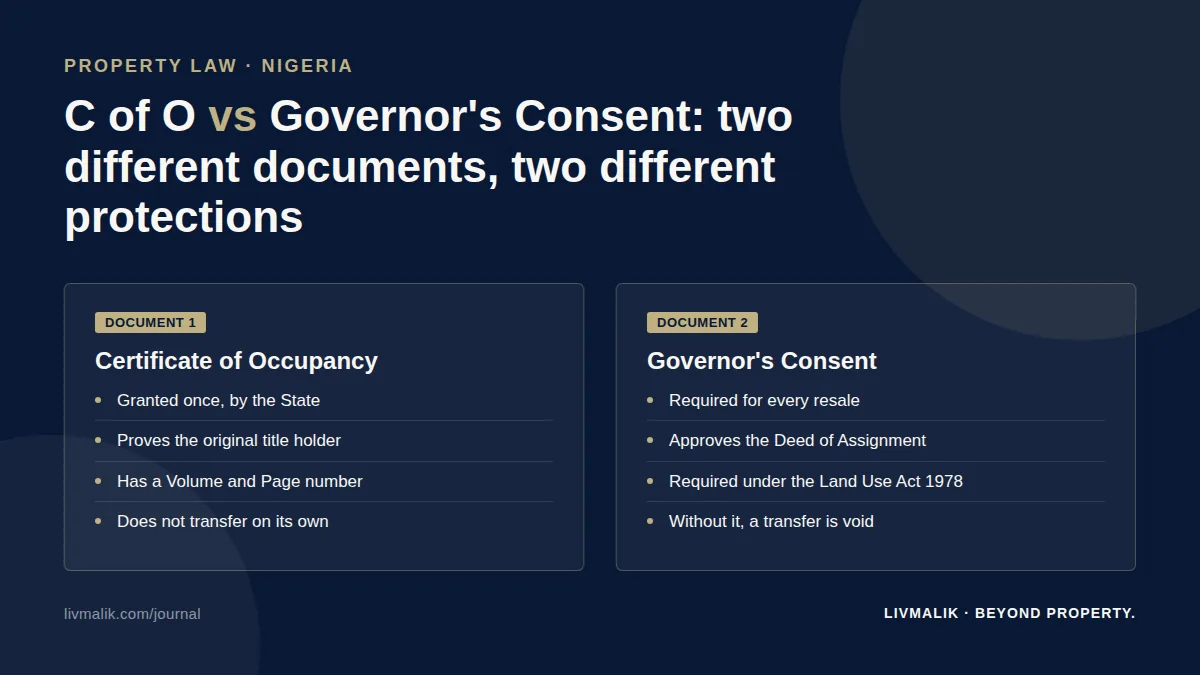
Nigeria's Land Use Act 1978 vests all land in every state, including Oyo State, in the Governor, who holds it in trust for the people. This single provision is why every subsequent land transaction in Nigeria, from the first grant to the tenth resale, runs through two separate gates: the document that proves title exists, and the state consent that lets it move from one person to another. Sellers and agents routinely use the terms "C of O" and "Governor's Consent" interchangeably, and buyers who do not know the difference cannot tell when they are being shown one but not the other.
Diaspora buyers are especially exposed. Reviewing documents by video call or from a scanned PDF, without a local lawyer physically at the Lands Registry, makes it easy to accept a seller's word that "the papers are complete" when what is complete is only the C of O, not the Consent for the sale actually being offered. Our guide on how to buy land in Nigeria from abroad covers the wider process; this article goes deep on the one distinction inside that process that trips up the most buyers.
A Certificate of Occupancy is a document issued by a State Government confirming that a named person or company holds a statutory right of occupancy over a specific parcel of land, for a term of years (typically 99), subject to the terms of the Land Use Act. It carries a Volume and Page number recorded at the state Lands Registry, so it can be independently verified.
A C of O answers one question: who is the recognised title holder of this land, as far as the state's records show? It does not, on its own, answer whether the person currently offering to sell you that land is entitled to transfer it to you today.
Under Section 22 of the Land Use Act 1978, a holder of a statutory right of occupancy cannot alienate that right, whether by sale, mortgage, transfer, or sublease, without first obtaining the Governor's Consent. Section 26 goes further: any such alienation carried out without Consent is null and void.
In plain terms, Governor's Consent is the state's approval of a specific transaction between a specific seller and a specific buyer. It is applied for after a Deed of Assignment has been prepared, and it is what makes that particular sale legally complete. A brand new C of O does not need Consent to exist; the moment that same land is sold on, the new transaction does.
Both documents live at the same Lands Registry, both get called "the papers" in everyday conversation, and both are genuinely required at different points in the same transaction. A seller who says "we have the C of O" may be telling the truth about the original grant while leaving out that Consent for your specific purchase has not yet been sought, applied for, or granted. This is not always deliberate fraud; it is often simply the seller not distinguishing between the two, or hoping the buyer will not ask.
What to ask instead of "do you have the papers": ask for the C of O Volume and Page number, ask whether a Deed of Assignment has been prepared for this specific sale, and ask what stage the Governor's Consent application is at. Three separate, specific questions, because they are three separate facts.
Legally, Section 26 makes an unconsented alienation void. Practically, this means a buyer who pays in full and takes possession without Consent being sought or in progress is exposed: their claim to the land can later be challenged, and resolving it usually means going back to formalise the very Consent that should have been in motion from the start.
This is different from a transaction where Consent has been applied for and is progressing through the Lands Bureau while the buyer pays in stages. A documented, in-progress application is evidence of a genuine, ongoing transaction. Silence on the subject, or a seller who insists Consent is "not necessary" for your purchase, is the red flag. It sits alongside the other warning signs in our article on Nigeria property scams: 7 red flags every buyer should know.
| Question | Certificate of Occupancy | Governor's Consent |
|---|---|---|
| What it proves | Who holds statutory title to the land | That a specific sale of that land is state-approved |
| When it is issued | Once, at the original grant or regularisation | Every time the right of occupancy is transferred |
| Legal basis | Land Use Act 1978, statutory right of occupancy | Land Use Act 1978, Sections 22 and 26 |
| How to verify | Volume and Page search at the state Lands Registry | Ask the seller's lawyer for the application reference and current status |
| If missing | Title is unverifiable; treat as a red flag | Transfer is not yet legally complete; find out why and get it in writing |
The verdict: neither document protects you on its own. A C of O without progress toward Consent tells you the land is real but not that your purchase of it is legally finished. Consent without a genuine, verifiable C of O behind it is approving a transfer of something that was never properly proved. Buyers need to see the whole chain, not one link.
There is no fixed statutory turnaround time published for Governor's Consent applications, and how long a file takes depends on the specific Lands Bureau workload, the completeness of the application, and whether any queries are raised on the file. Buyers and their lawyers should ask the Oyo State Lands Bureau directly for the status of a specific application rather than accept a round figure from a seller. Any promise of consent "within days" for a standard resale should be treated with caution.
"The honest answer is that we do not control the Lands Bureau's calendar, and we tell buyers that directly," says Adebayo Malik Adekola, Founder of LivMalik. "What we control is whether our own paperwork is complete, correctly filed, and prepared by a solicitor who has done this before. That is what actually shortens the wait."
The land for Project I, Eden, at Block IV, Plots 2 and 3, Educational Zone Layout, Ring Road GRA, Ibadan, originates from a Certificate of Statutory Right of Occupancy, Volume 3053, Page 60, granted in 1992. The parcel was officially sub-divided in 2019 by the Oyo State Ministry of Lands, Housing and Survey, under Sub-Division Plan No. IB.1752. Plots 2 and 3 were then assigned to LivMalik's founder by a Deed of Assignment prepared by Bashmash Solicitors, and cover the three homes described on The Homes.
Governor's Consent for that Deed of Assignment is currently in progress at the Oyo State Lands Bureau. LivMalik states this as a fact rather than implying it has already been granted, and the status is available to any buyer's lawyer on request, alongside the C of O reference and the sub-division plan number. This is what "documented build progress" means applied to paperwork rather than bricks: every stage is named, dated, and checkable. The full title chain, payment structure, and build specification are published on How We Work.
"Reviewed by Basirat F. Momoh Esq., Bashmash Solicitors, Ibadan," is not a formality on our legal articles," Malik adds. "It means a practising, NBA-registered solicitor has actually read what we are telling buyers about their own title chain."
If a seller cannot answer questions one and two, do not proceed. If they cannot answer three and four honestly, get an independent lawyer involved before you send a single naira.
Yes. A Certificate of Occupancy is granted once to a title holder. Every time that property is sold on, the new transfer needs its own Governor's Consent. A property can have a perfectly valid C of O in the seller's name while the specific sale to you still awaits Consent.
No. Buyers routinely sign a Deed of Assignment and pay in stages while the Consent application is being processed by the state. What matters is that the underlying title is genuine, the Deed is prepared and lodged, and the seller is transparent that Consent is in progress rather than pretending it is already granted.
There is no fixed statutory timeline, and processing time varies by file and by state workload. Buyers and their lawyers should ask the Oyo State Lands Bureau for a current status update rather than rely on a fixed figure, and should treat any promise of an overnight approval with suspicion.
A Deed of Assignment is the legal document that records the sale, the parties, the price, and the description of the land. Governor's Consent is the state's separate approval of that Deed. The Deed can be signed immediately; the Consent is what the Land Use Act requires before the transfer is fully valid.
The Deed of Assignment for Block IV, Plots 2 and 3 is prepared and Governor's Consent is in progress at the Oyo State Lands Bureau. LivMalik states this plainly rather than implying Consent has already been granted, and updates buyers as the file moves.
Section 26 of the Land Use Act 1978 states that any alienation of a right of occupancy without the required Consent is null and void. In practice this means the buyer's claim to the land can be challenged, which is why a documented, in-progress Consent application matters far more than a verbal assurance.
LivMalik Project I, Eden, publishes its full title chain, from the original 1992 Certificate through to the current Governor's Consent application, and names the solicitor behind it. Register your interest and ask your lawyer to verify us.