A C of O is the document most Nigerian property conversations revolve around, and the one most often waved at buyers as proof that everything is fine. Here is what it actually proves, what it does not, and the specific steps to verify one at the Oyo State Lands Registry.
By Adebayo Malik Adekola, Founder, LivMalik. Published 11 July 2026. Last updated 11 July 2026. Reviewed by Basirat F. Momoh Esq., Bashmash Solicitors, Ibadan.
A Certificate of Occupancy (C of O) is the document a State Governor issues under the Land Use Act 1978, naming a person or company as holder of a statutory right of occupancy over a specific parcel of land, usually for 99 years. It is strong, prima facie evidence of that right, not an automatic guarantee against every other claim. In Oyo State, a genuine C of O carries a Volume and Page number that can be independently checked against the Lands Registry in Ibadan, and that check is the single most useful thing a buyer can do before paying anything.
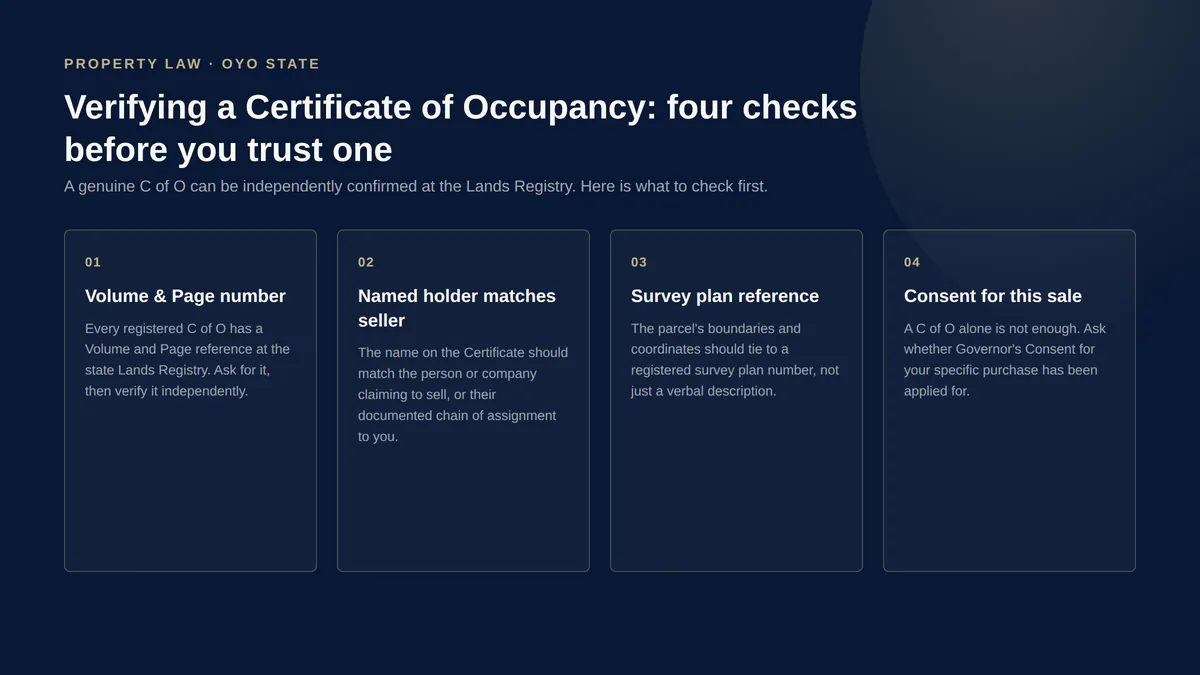
Ask any Nigerian property buyer what makes land "safe" to buy, and most will answer with three words: "it has C of O." The Certificate of Occupancy has become shorthand for a clean transaction, which is exactly the problem. A C of O is genuinely important, but treating it as the only document that matters leaves buyers exposed to the other checks a real transaction needs, and it gives dishonest sellers an easy line to repeat.
How much this matters varies enormously by state and by file. The World Bank's now-discontinued Doing Business project, in its final published dataset, measured registering a property in Lagos at an average of 105 days and in Kano at 47 days; Oyo State was not separately measured. The spread between those two cities alone shows why a fixed timeline is unreliable and why buyers should ask about the specific status of their own file rather than accept a round number from anyone selling to them.
Diaspora buyers face this at a distance, often reviewing scanned documents from London, Houston, or Toronto with no way to walk into the Lands Registry themselves. Our guide on how to buy land in Nigeria from abroad covers the full purchase process; this article goes deep on the one document that gets over-trusted more than any other.
The Land Use Act 1978 vests all land in every Nigerian state, including Oyo State, in the Governor, who holds it in trust for the people. Section 5(1)(a) gives the Governor power to grant a statutory right of occupancy over land in urban areas to any person or organisation for any purpose, for a definite term. The Certificate of Occupancy is the physical document evidencing that grant: it names the holder, describes the parcel, states the term (typically 99 years), and is recorded under a Volume and Page number at the state Lands Registry.
A C of O is not a title deed in the sense used in England or the United States. It is a right to occupy and use land under the Land Use Act's framework, which is why lawyers describe it as the strongest form of land holding available in Nigeria rather than as outright freehold ownership.
It proves a great deal, but not everything, and buyers who assume it is unchallengeable are working from the wrong legal premise. In the Supreme Court case Joshua Ogunleye v Babatayo Oni (1990), the court held that a Certificate of Occupancy raises a rebuttable presumption that the holder has a right of occupancy over the land: "a general statement that may be made about the certificate of occupancy is that it raises a presumption in favour of the holder, albeit a rebuttable presumption that the holder has a right of occupancy. The onus of disproving this right is on the person who asserts the contrary."
In plain terms: a C of O is strong evidence, and the burden falls on anyone disputing it to prove a better claim existed first. In the Ogunleye case itself, the party without a Certificate successfully did exactly that, by proving an earlier valid right to the same land. This is precisely why other checks, a survey plan reference, a documented chain of assignment, and a genuine search at the Registry, matter alongside the Certificate itself, not instead of it.
No, and confusing the two is one of the most expensive mistakes a buyer can make. A C of O is issued once, to the original or current title holder. Governor's Consent is a separate approval required under Section 22 of the Land Use Act every time that right of occupancy is transferred, sold, or mortgaged. A seller can hold a completely genuine C of O and still be unable to legally complete a sale to you until Consent for that specific transaction has been sought and granted. We cover this distinction, and what happens legally when a transfer proceeds without Consent, in full in C of O vs Governor's Consent: which one actually protects you.
Applications are made to the Oyo State Ministry of Lands, Housing and Urban Development. In general terms, an applicant needs evidence of how the land was acquired (a purchase receipt, a family land document, or an existing deed), a registered survey plan showing the parcel's boundaries and coordinates, passport photographs, and payment of the statutory fees and ground rent the Ministry sets. Fee schedules and required forms change periodically, so anyone applying should request the Ministry's current requirements directly rather than rely on figures found in older articles online, including this one.
Processing an application can take anywhere from several months to considerably longer, depending on the completeness of the file and the Ministry's workload at the time. This is a different process from Governor's Consent, which applies to a resale of land that already has a C of O; a first-time application for a new Certificate is a longer, separate process from end to end.
This is the question that actually protects your money, and the answer is more concrete than most guides make it sound.
Oyo State has been moving elements of its land records online in recent years, and buyers should ask the Ministry of Lands, Housing and Urban Development or their lawyer for the current, correct way to lodge a search, since the exact process and fees can change. What does not change is the underlying principle: a Volume and Page number that cannot be independently confirmed at the Registry is not a verified Certificate, however official the photocopy looks. This kind of unverifiable paperwork sits alongside the other patterns covered in Nigeria property scams: 7 red flags every buyer should know.
For buyers instructing a search from the UK, US, or Canada, the practical version of this advice is simple: never rely on your own read of a scanned document. Instruct a Nigeria-based lawyer, ideally one you chose rather than one the seller suggested, to conduct the Registry search in person and report back with what they actually found on file.
| Sign | Likely genuine | Worth investigating further |
|---|---|---|
| Volume and Page number | Clearly printed, confirmed by an independent Registry search | Missing, illegible, or the seller resists you checking it yourself |
| Holder's name | Matches the seller or a documented chain of assignment to them | A different name, with no Deed explaining the gap |
| Survey plan | Registered plan number, boundaries match what you are shown on site | No plan number, or boundaries described only verbally |
| Governor's Consent for this sale | Applied for and disclosed, even if still in progress | Seller says Consent "is not necessary" for your purchase |
The land for Project I, Eden, at Block IV, Plots 2 and 3, Educational Zone Layout, Ring Road GRA, Ibadan, traces to a Certificate of Statutory Right of Occupancy, Volume 3053, Page 60, granted in 1992. The parcel was officially sub-divided in 2019 by the Oyo State Ministry of Lands, Housing and Survey under Sub-Division Plan No. IB.1752. Plots 2 and 3 were then assigned to LivMalik's founder by a Deed of Assignment prepared by Bashmash Solicitors, covering the three homes described on The Homes. Governor's Consent for that Deed is currently in progress at the Oyo State Lands Bureau, and LivMalik states that plainly rather than implying it has already been granted.
"We publish the Volume and Page number precisely so a buyer's lawyer does not have to take our word for anything," says Adebayo Malik Adekola, Founder of LivMalik. "If you cannot independently confirm what a developer tells you about their title, that is a reason to slow down, not a technicality to skip."
The full title chain, sub-division plan reference, and payment structure are published on How We Work, alongside the same documented, milestone-based approach we apply to construction. Buyers, or their lawyers, are welcome to verify every reference against the Oyo State Lands Registry independently.
Not quite. Under the Land Use Act 1978, all land is vested in the State Governor. A Certificate of Occupancy grants a statutory right of occupancy, usually for a term of 99 years, which is the strongest form of land holding available under Nigerian law. Courts treat it as strong evidence of that right, not as an automatic, unchallengeable guarantee.
Yes. The Land Use Act allows a Governor to revoke a right of occupancy for overriding public interest, such as a road or public works project, usually with compensation. A Certificate can also be successfully challenged in court by someone who proves a valid, earlier claim to the same land.
Ask for the Volume and Page number recorded on the Certificate and take it, or instruct your lawyer to take it, to the Oyo State Lands Registry in Ibadan for an independent search. The search confirms whether the Certificate is genuinely registered, in whose name, and over which parcel. Do not accept a photocopy or a verbal assurance as a substitute for that search.
The land for Project I, Eden, at Block IV, Plots 2 and 3, Ring Road GRA, Ibadan, traces to a Certificate of Statutory Right of Occupancy, Volume 3053, Page 60, granted in 1992 and sub-divided in 2019 under Sub-Division Plan No. IB.1752. Plots 2 and 3 were assigned to LivMalik's founder by a Deed of Assignment, and Governor's Consent for that Deed is in progress at the Oyo State Lands Bureau.
A Certificate of Occupancy is the state's grant of a right of occupancy to a named holder. A Deed of Assignment is the private legal document recording the sale of that right from one party to another. When land is resold, the Deed of Assignment is what the buyer signs, and it then needs Governor's Consent to be fully valid, separate from the original Certificate.
LivMalik Project I, Eden, publishes its Certificate of Occupancy reference, sub-division plan number, and current Governor's Consent status, and names the solicitor behind it. Register your interest and ask your lawyer to verify us.